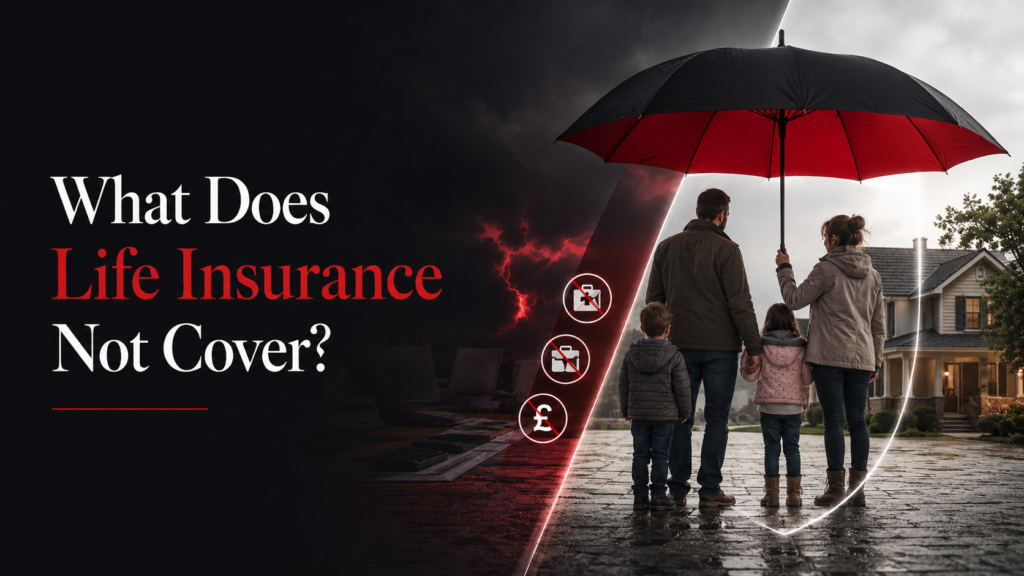
What Does Life Insurance Not Cover?
Life insurance can feel like an important financial safety net a way to protect your loved ones financially if you pass away.
However, like most insurance policies, life insurance has limits. Understanding what life insurance does not cover can help you choose the right protection insurance for your needs and avoid assuming you are protected in situations where your policy may not pay out.
In this guide, we explain what life insurance is, what life insurance does not usually cover, and how other protection products such as critical illness cover and income protection insurance may help fill some of those gaps.
This article is designed to help UK individuals and families understand their options clearly, without confusing jargon.
What Is Life Insurance?
Life insurance is a financial protection product that pays out a lump sum to your beneficiaries if you die during the policy term.
The payout can be used for things such as:
- Paying off a mortgage
- Covering household bills
- Supporting your family financially
- Helping with childcare costs
- Managing outstanding debts
- Providing financial stability after death
There are different types of life insurance available in the UK, but the most common include:
| Type of Life Insurance | How It Works |
|---|---|
| Term Life Insurance | Covers you for a set period, such as 20 or 25 years. It usually pays out if you die during the policy term. |
| Whole of Life Insurance | Covers you for your entire life and usually pays out when you die, subject to policy terms and conditions. |
Life insurance can be valuable, but it is important to understand what it covers and what it does not.
What Life Insurance Does Not Cover
A standard life insurance policy is mainly designed to pay out when the policyholder dies.
It does not usually provide financial support if you are alive but unable to work, seriously ill, unemployed, or facing general financial difficulty.
Here are some of the main things life insurance may not cover.
1. Critical Illnesses and Serious Health Conditions
A standard life insurance policy generally does not pay out if you become seriously ill but do not die.
For example, life insurance may not pay out if:
- You are diagnosed with cancer and need treatment
- You have a heart attack but survive
- You suffer a stroke and are unable to work
- You are diagnosed with a long-term illness
- You need time away from work due to a serious medical condition
These situations do not usually result in a life insurance payout because you are still alive.
For this reason, many people choose to add critical illness cover to their policy or take out a separate critical illness insurance plan.
Critical illness cover can pay a lump sum if you are diagnosed with one of the specified illnesses or conditions listed in the policy.
Real-Life Example
Jane took out a term life insurance policy to protect her family.
Two years later, she was diagnosed with multiple sclerosis, which meant she could no longer work. Her life insurance did not pay out because she had not died.
However, if Jane had critical illness cover and her condition met the policy definition, it may have helped her manage the financial impact.
2. Loss of Income If You Cannot Work
Life insurance does not usually provide money during your lifetime if you are unable to work due to illness or injury.
This can be a major issue if your household depends on your income.
For example, life insurance usually will not cover:
- Monthly mortgage payments while you are off work
- Rent payments
- Utility bills
- Food and household costs
- Childcare expenses
- Loss of earnings due to illness or injury
To protect against this risk, many people consider income protection insurance.
Income protection insurance is designed to replace part of your income if you cannot work due to illness or injury, subject to eligibility, underwriting, deferred periods, and policy terms.
This is different from life insurance, which usually pays a lump sum only on death.
Real-Life Example
Mark was in a car accident and could not work for six months.
His life insurance did not pay anything because he was still alive. Thankfully, he had income protection insurance, which helped cover his mortgage and household bills while he recovered.
3. Death by Suicide or Certain Other Causes Within the Early Policy Period
Most UK life insurance policies include a suicide clause.
This means that if the policyholder dies by suicide within the first one or two years of the policy, depending on the insurer, the insurance company may not pay the claim.
Some policies may also exclude or restrict payouts for deaths linked to:
- Dangerous activities
- Extreme sports
- Illegal activities
- Non-disclosure of important information
- Certain high-risk occupations or hobbies
It is important to read the policy terms carefully so you understand any exclusions, limitations, or claim conditions before taking out cover.
4. Pre-Existing Medical Conditions
If you have existing health problems when you apply for life insurance, these may affect whether you are accepted and how much you pay.
Insurers may:
- Increase the premium
- Apply exclusions
- Ask for medical evidence
- Decline the application
- Offer cover with specific conditions attached
If a claim is made for a condition that existed before the policy started and that condition was not disclosed during the application, the claim could be rejected.
This is why it is important to answer all application questions honestly and accurately.
5. Financial Hardship Not Linked to Death or Illness
Life insurance is not designed to cover everyday financial difficulties unless they relate to your death.
For example, life insurance usually will not cover:
- General credit card debts while you are alive
- Loss of income from unemployment
- Missed mortgage payments due to budgeting issues
- Business cash flow problems
- General living costs while you are still working
- Financial mistakes or poor spending decisions
If you are concerned about being unable to work due to sickness or injury, income protection insurance may be more relevant.
If you are concerned about redundancy or unemployment, you may need to explore separate unemployment cover or accident, sickness and unemployment protection, where available and suitable.
Life Insurance vs Critical Illness Cover vs Income Protection
Life insurance is useful, but it is not the same as critical illness cover or income protection.
Each type of protection insurance serves a different purpose.
| Protection Type | What It Usually Covers | How It Pays Out | When It May Help |
| Life Insurance | Death during the policy term | Lump sum | Helps protect loved ones financially after death |
| Critical Illness Cover | Specified serious illnesses listed in the policy | Lump sum | Helps if you survive a serious illness but face financial pressure |
| Income Protection Insurance | Inability to work due to illness or injury | Regular monthly income | Helps replace part of your income while you recover |
| Unemployment Cover / ASU Cover | Redundancy, accident or sickness depending on the policy | Monthly benefit | Helps with short-term financial pressure, subject to policy terms |
Why Consider Other Protection Insurance?
Because life insurance does not cover every financial risk, other protection policies may provide a more complete safety net.
Life insurance may help your family if you pass away.
However, it may not help if:
- You become seriously ill but survive
- You cannot work due to illness or injury
- You need time off work for treatment or recovery
- Your income stops temporarily
- Your household bills continue while you are alive but unable to earn
This is where critical illness cover and income protection insurance can play an important role.
Critical Illness Cover
Critical illness cover is designed to pay a lump sum if you are diagnosed with a specified serious illness covered by the policy.
Conditions often covered may include:
- Certain types of cancer
- Heart attack
- Stroke
- Kidney failure
- Multiple sclerosis
- Major organ transplant
- Other serious conditions listed in the policy
The payout can usually be used however you choose.
For example, it may help with:
- Mortgage payments
- Household bills
- Private treatment costs
- Home adaptations
- Childcare
- Recovery time away from work
- Reducing financial pressure during illness
It is important to remember that critical illness cover only pays out for conditions listed in the policy and where the insurer’s definition is met.
Income Protection Insurance
Income protection insurance is designed to replace part of your salary if you are unable to work due to illness or injury.
It can help cover essential expenses such as:
- Mortgage or rent payments
- Utility bills
- Food and household costs
- Childcare
- Transport costs
- Regular financial commitments
Many income protection policies pay a monthly benefit after a waiting period, known as a deferred period.
Depending on the policy, cover may continue until you return to work, the policy term ends, or you reach the maximum benefit period.
Unlike life insurance, income protection is designed to support you while you are alive but unable to work.
How to Choose the Right Protection Insurance
Choosing the right protection insurance depends on your personal and financial circumstances.
Before deciding, it can help to think about:
- How much financial support your family would need if you died unexpectedly
- Whether your mortgage would still be affordable without your income
- Whether your partner or family depends on your earnings
- How long you could manage financially if you could not work
- Whether you have savings to cover illness, injury, or time away from work
- Whether you want a lump sum payout, monthly income support, or both
- Whether you have existing medical conditions that may affect your options
The right protection plan is not always just one policy.
For many people, a combination of life insurance, critical illness cover, and income protection may offer broader financial protection.
Key Things to Check Before Taking Out Life Insurance
Before taking out life insurance or any protection insurance policy, it is important to check:
- What the policy covers
- What the policy does not cover
- Any exclusions
- The policy term
- The payout amount
- Whether premiums are guaranteed or reviewable
- Whether critical illness cover is included or separate
- Whether income protection may be more suitable for income loss
- How pre-existing medical conditions are handled
- Whether the cover matches your mortgage, family, and income needs
Reading the policy documents carefully can help avoid confusion at claim stage.
Final Thoughts
Life insurance is a valuable way to protect your family from financial hardship after your death.
However, it is important to understand what life insurance does not cover, especially serious illness, loss of income, and financial problems that happen while you are still alive.
For many people, combining life insurance with other protection insurance products such as critical illness cover and income protection insurance may provide greater peace of mind.
If you want to understand what cover may be suitable for your circumstances, speaking to an experienced protection adviser can make the process clearer.
Speak to BSL Assured Today
If you are wondering what types of protection insurance are right for you, BSL Assured can help.
Our team provides straightforward, honest guidance tailored to your circumstances no jargon, just clear information.
Get in touch with BSL Assured today to discuss your protection insurance options and explore how you may be able to protect your family’s financial future.
Note: This blog is for informational purposes only and does not constitute regulated financial advice. Please consult a qualified adviser for personal recommendations. Cover is subject to eligibility, underwriting, exclusions, and policy terms.